
Travel log

coucher du soleil

Archive for September 2026

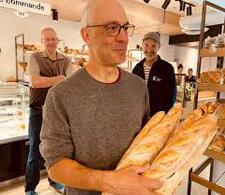
Patrick Nisot moved to Québec with his parents from Belgium in 1986. He started out studying agronomy at Université Laval, thinking it covered everything about food, what people grow, how they grow it, and what ends up on their plates. But baking was always on his mind.

Twenty-five years later, his four La Boîte à Pain bakeries in Québec employ 150 people.
La Boîte à pain 2026 La Boîte à pain 2026

The idea really took shape when he was 26, working on a grain farm in Saskatchewan. That’s when he decided he wanted to run his own business. Back in Québec, he spent the summer figuring out his next move. Baking had always been his dream, ever since he was a kid visiting his grandparents’ bakery in a small French village, where they made an incredible baguette. He could still picture himself sliding loaves into the oven.

With help from employment insurance, he took a bakery course in Montréal-Nord to get the skills he needed. After that, he worked at a bakery on rue Cartier in Québec, soaking up everything he could about the trade.

When Patrick tried to open his own bakery in 1999, banks turned him down. He’d spent six months putting together a solid business plan and even got it approved by the CLD de Québec. But it was the Fonds d’emprunt Québec that finally gave him a chance, lending him $15,000 to get started. The organization helps local entrepreneurs who can’t get traditional financing.

Then, on October 19, 1999, at 3:30 a.m., after two years of planning, training, renovations, and test runs, Patrick turned on the mixer at La Boîte à Pain. The space was on rue Saint-Joseph in Saint-Roch. He started with a white dough made with poolish , 25 kilograms of it, shaped into 20 baguettes, 10 Belgian loaves, 10 white squares, 10 round loaves, and a few ficelles.

The mixer had been running for three days straight, and the oven was already hot. The first test loaves went to curious neighbors who’d gathered outside. The bakery door was still covered in brown paper, waiting for the official opening, but Patrick had to let people in, the place was sweltering without any ventilation. They handed out bread fresh from the oven. It was the best way to see if customers would like it. They did.

When they finally opened for business, they sold 15 baguettes a day in the first week. After that, sales doubled every year. By 2002, they had about 20 employees at just one location.

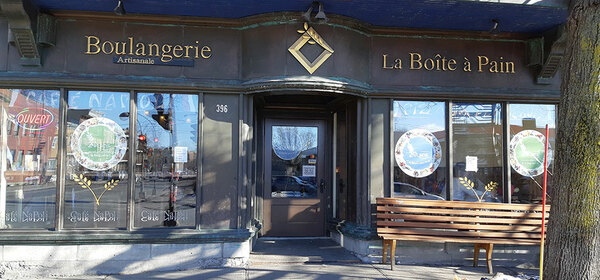
In the spring of 2007, Patrick came back from Naples, Italy, with a new idea: Neapolitan pizza. At the time, no one in Québec was making it. The problem? You need an oven that gets much hotter than a bread oven. He found one in Lévis, tucked away in a storage building. A year later, on April 1, 2008, La Boîte à Pain/Café Napoli opened in Limoilou, built around that oven.


La Boîte à pain 2026 La Boîte à pain 2026

The same setup opened in Sainte-Foy in 2015 and at the Grand Marché de Québec in 2019. The Grand Marché location only sells products, while the other two are both bakeries and pizzerias. Meanwhile, the original La Boîte à Pain moved to rue du Parvis in Saint-Roch, just a short walk from where it all started.

Since 2014, they’ve also had a production center where they make about 40 kinds of artisanal bread. Back in 1999, they mostly sold white, wheat, and rye bread, baguettes, croissants, chocolatines, and brioches. Now, they distribute around 3,000 croissants and 10,000 viennoiseries to their four locations every week. Over 25 years, Patrick has seen the world of bread and pastries change alongside his team of bakers and artisans.
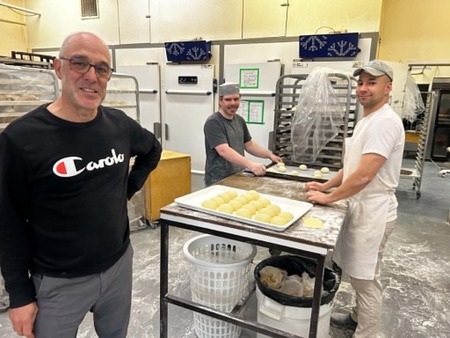
La Boîte à pain 2026 Patrick Nisot with employees from the production centre

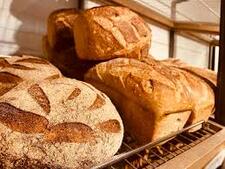
Today, La Boîte à Pain offers 40 types of bread, about 20 Neapolitan-style pizzas, gourmet sandwiches made fresh daily, a dozen kinds of viennoiseries, pastries in all sizes, and market products tailored to what customers want. Everything is made with top-quality flour and fresh ingredients from trusted local suppliers. For Patrick, there’s no room for compromise when it comes to quality.

He’s still the one calling the shots, but in 2024, he brought in a general manager, Jean-François Gagné, to handle day-to-day operations and production. Jean-François is set to become a shareholder, and Patrick hints that new projects are in the works, maybe even with partners. But in the spring of 2026, he’s keeping the details under wraps.

La Boîte à pain 2026

La Boîte à pain
boiteapain.com
Saint-Roch
432 rue du Parvis, Québec
418 647-3666

Sainte-Foy
2836, chemin Sainte-Foy, Québec
418 914-1133

Café Napoli (Limoilou)
396, 3e Avenue, Québec
418 977-7571

Grand Marché de Québec
250, boulevard Wilfrid-Hamel, Québec
418 692-2517 ext. 105

In Greek mythology, he is the master and regulator of the winds. In a vast cavern, Aeolus keeps the winds and noisy storms chained and imprisoned, striving to escape. In Cap-Chat, Gaspésie, since 1994, people have been visiting the great Aeolus, one of the world's largest vertical-axis wind turbines.

Projet Éole Projet Éole
In 2019, two Gaspésie enthusiasts, Benjamin Leduc and Benoit Bénéteau, acquired the vertical-axis wind turbine of Cap-Chat. A new young and dynamic management team is in place, bringing together diverse experiences. The ambitions of these promoters are significant for this project, which was nearly abandoned at one time, but is now undergoing complete revaluation and transformation. "Former wind research laboratory becomes a laboratory on the environment and renewable energy," explain its co-owners.


"I see the site as a unique industrial heritage in the world," Benjamin Leduc declared in an interview with Radio-Canada shortly after the acquisition. The site is intended for tourist purposes and presents the project as a monument dedicated to Quebec's technological heritage and is also an interpretation center on wind energy. The artistic and educational aspects around the theme of wind energy, omnipresent all around, are also being developed.

"Our concept is a bit like a research project of a research project," he explains, to demonstrate the unique and fascinating aspect of their commitment.

Projet Éole
Located in the middle of an important wind farm in the region that adorns the plateaus at some distance from route 132 along the Saint Lawrence estuary, Éole is a relic from the beginnings of renewable energy research in Quebec. The 110-meter-high giant was an important step in the development of wind power. Anyone traveling in the area is surprised by the immensity of this large vertical ellipse that overlooks the landscape.


Built in the mid-1980s, Éole was decommissioned since 1993, following an unexpected strong wind that damaged the main bearing of the device, probably also due to the enormous weight of this structure. The power station was not in operation long enough to transition from experimental mode to the status of a modern electric power plant. The project launched by Hydro-Québec pooled resources from the National Research Council Canada (NRCC) and the Quebec Electricity Research Institute (IREQ) to develop these technologies in North America.

It is also important to understand that this experimental wind turbine, entirely made of steel, was erected at a time when the composite materials that characterize the blades of today's wind turbines were not yet available.

 Projet Éole Projet Éole 
The two partners and co-owners wish to invest more in modernizing the tourist site. They see a lot of potential. In addition to knowledge transmission, they propose discovering the Éole site through various initiatives and playful activities. The site is intended to be a leading attraction for Gaspésie. "A place of wonder and discoveries," adds Benjamin Leduc. Beyond the technological and scientific aspect, the Éole Project also wants to capitalize on the growing interest in self-production of electric energy through small wind turbines. It will offer training and workshops for those interested in getting involved.


The visit to the Éole Project includes:
- Discovering the experimental energy plant built in the 80s.
- Entering the generator and seeing all its vestiges to understand its unique design.
- Explanatory panels on the history of Éole, wind power development, and current industry facts, along with a guide to answer all your questions.
- A panoramic viewpoint with a 360 view to admire the picturesque landscape of the Nordais wind park (first in Quebec) and its surroundings (Cap-Chat, the sea, and the Chic-Chocs mountains), as well as a closer view of the tower.

Projet Éole  Projet Éole

A Foundation to Ensure Its Future
Finally, let us mention the creation of the Fondation Éole, a new development tool for the project. It is an organization focused on the education of renewable energies and sustainable development. It will develop in a way to popularize and share new developments related to these current topics, all within a playful framework and a purpose of integration into community and cooperative initiatives.


Conferences, educational workshops, physical and digital documentation, research and development in energy, and community involvement are the vectors of progress for the foundation. It will provide tools for exporting and disseminating information, content, and vision beyond the physical boundaries of the site. Both will evolve in synergistic development in the coming years. The foundation will synthesize the information present on the site for national dissemination.

An Attraction for the Whole Family

The Éole Project welcomes visitors every year from June 15 to October 1, 7 days a week, from 9 am to 5 pm. A visit that will interest the whole family with its originality and related educational activities. Visitors can also have a picnic, walk through flowered trails, and a permaculture garden at the foot of Éole. The wind-themed souvenir shop at the reception and on the site offers local Gaspesian crafts and unique Éole products.


Éole Project

projeteole.ca
5, chemin du Cap
Cap-Chat (Québec) G0J 1E0
418 967-8812

RSS Feed

Subscribe

Categories

Tags

Latest Posts

Archives