

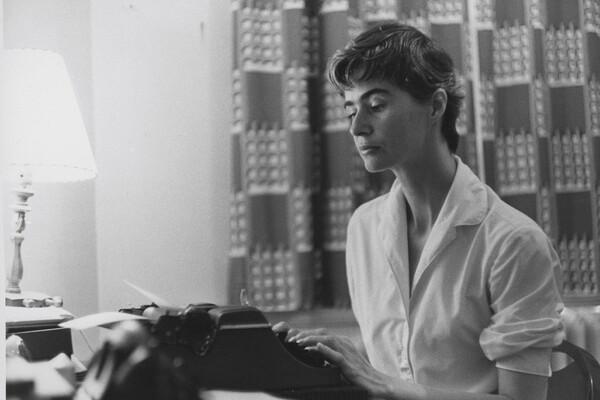
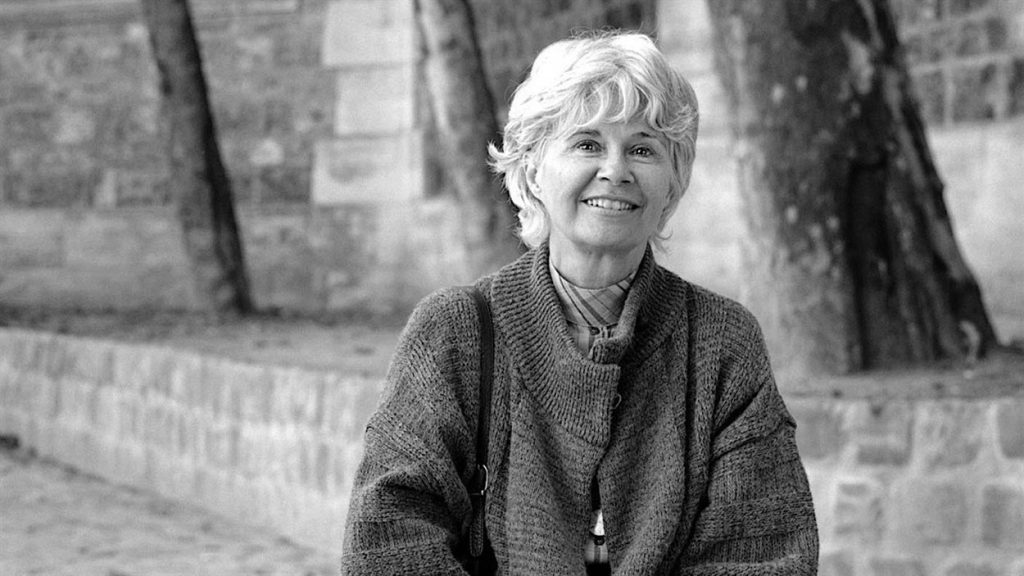
On August 1st, 2016, writer and poet Anne Hébert would have turned 100. Her centenary was to be commemorated in 2017 in Kamouraska, the village where her novel Kamouraska is set. The book made her famous and put the village on the map. Adapted for the big screen by Claude Jutra, with music by André Gagnon, the film introduced her work to the general public.
Anne Hébert was born in Sainte-Catherine-de-la-Jacques-Cartier and spent her childhood in Québec. But as a descendant of the seigneurial family of Kamouraska, she spent several summers there, where she became familiar with the famous crime of passion involving her ancestor. After publishing various poetry collections from 1942 to 1953, in 1958 she published her first novel, Les Chambres de bois, with Éditions du Seuil, and in June 1960 was elected a member of the Royal Society of Canada.
In 1965, after her mother’s death, she moved to Paris. She finally achieved success with the publication of Kamouraska in 1970, which earned her the Prix des libraires de France. In 1975 she published Les enfants du sabbat, her third novel, followed in 1980 by a fourth, Héloïse. Her fifth novel, Les Fous de Bassan (1982), made her the fourth French-Canadian woman and the second Québécoise to win one of France’s major literary prizes: the Prix Femina. She was preceded only by Gabrielle Roy, also a Femina winner, Marie-Claire Blais, winner of the Médicis, and Antonine Maillet, winner of the Goncourt. Between 1969 and 1983, she received honorary doctorates from the University of Toronto (1969), the University of Guelph (1970), UQÀM (1979), McGill University (1980) and Université Laval (1983).
In 1988, her sixth novel, Le Premier Jardin, paid tribute to the women who founded Nouvelle-France. A seventh novel, L’Enfant chargé de songes, appeared in 1992. In 1995, at the age of 79, she published Aurélien, Clara, Mademoiselle et le Lieutenant anglais, a story midway between poetry and prose. Her fifth and final poetry collection, Poèmes pour la main gauche, was published two years later.
Early in 1998, after 32 years in Paris, she returned to Montréal. In 1999, her last novel, Un habit de lumière, was published, a few months before her death in Montréal in January 2000.
Anne Hébert always remained discreet about her private life; she never married or had children. Living in Paris, far from home, enabled her to keep her artistic and private lives separate, as it did for her friend Mavis Gallant, an English-speaking Montréal writer who had also moved to the City of Light and with whom Hébert shared a long friendship.