The Musée des beaux-arts de Mont-Saint-Hilaire has a mission that distinguishes it from most Québec museums. Correlieu retrouvé, an exhibition by painter and author Mathieu Laca that opened on June 20 and runs through September 27, strongly advances that mission. It is a rare opportunity to mount a show directly aligned with the museum’s mandate, which includes preserving and showcasing the cultural legacy of Mont-Saint-Hilaire’s three masters: Ozias Leduc (1864–1955), Paul-Émile Borduas (1905–1960) and Jordi Bonet (1932–1979).
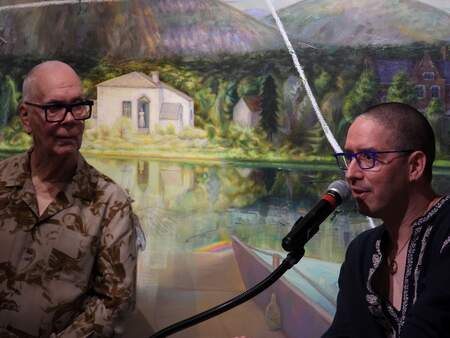 Mathieu Laca and Jean Comeau at the opening.
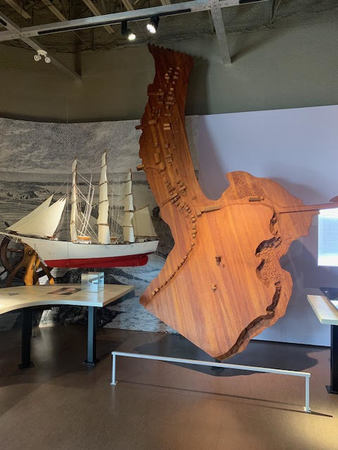
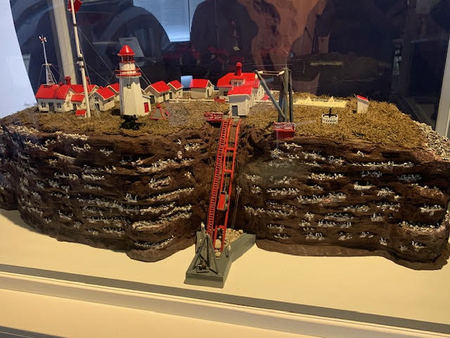
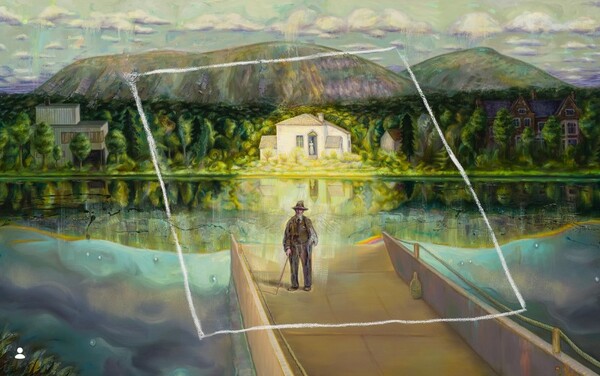
As part of the institution’s 30th-anniversary programme, painter Mathieu Laca’s exhibition brings these three major figures in Québec and Canadian history into dialogue. It draws on the legendary Correlieu studio, built by Ozias Leduc in 1890 and described as ‘a place where the heart is in everything’. The studio unfortunately disappeared in the 1980s after serving as a true meeting and exchange space for the artistic community from the late 19th century through the first half of the 20th. It also evokes the studio-homes of Bonet and Borduas through poetic scale models.
Together, the three artists lived in Mont-Saint-Hilaire across a span of 110 years. Leduc was born there and spent most of his life in the town. Borduas, also born there, became Leduc’s student as a teenager and later returned to build a house that still stands and is now part of the museum’s permanent collection. Among other works, he wrote Refus global there, denouncing the stifling narrow-mindedness of a Québec constrained at the time by traditional Catholic values. Jordi Bonet, born in Spain and established in Québec in the early 1950s, later fell in love with Manoir Rouville-Campbell and its Tudor Revival architecture beside the Richelieu. He acquired the badly deteriorated property in the early 1970s, lived there with his family and restored it room by room before having it classified as a historic monument in 1977.
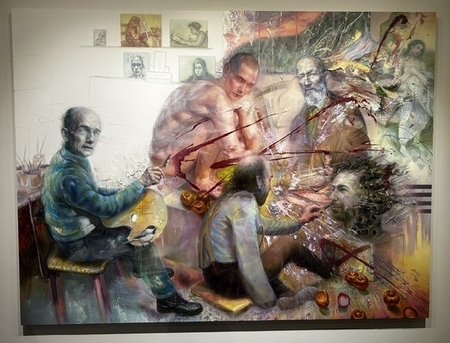
Following a 2024 dinner in Saint-Hilaire with Jordi Bonet’s children, Sonia and Laurent, Mathieu Laca and his partner, Jean, fell in love with what he describes as an almost hypnotic environment. ‘When I arrived in the town, I was also struck by place names that make it feel like an open-air museum. You cross pont Jordi-Bonet and travel along chemin Ozias-Leduc, rue Paul-Émile-Borduas and rue de l’Heure-Mauve. I then discovered that the property where Ozias Leduc (1864–1955) lived for almost his entire life was only a stone’s throw away,’ he explains, setting out the origins of the project that followed.
Through this original exhibition, Laca sought to offer a renewed perspective on the three artists and identify a defining theme in each body of work. Long, rigorous research allowed him to enter into their lived experiences and influences. In Leduc, he finds goodness, a quality that, according to the artist, might offer a path toward the divine. It seems to appear in the humility of Leduc’s subjects, including L’heure mauve, a half-snow-covered branch with dead leaves, as well as in his enveloping light and gentle brushwork. Borduas’s trajectory, in Laca’s view, was guided by a quest for freedom. Seeking release from the narrow morality embodied by religion, he continually pursued a pure, universal language through which to express the depths of his psyche and escape the constraints of figurative tradition. His work still resonates as a lesson in authenticity and sacrifice. Jordi Bonet’s life, meanwhile, was marked by profound tragedy: the Spanish Civil War, which ravaged his homeland from 1936 to 1939; the amputation of his right arm; and the death of his young son after he was struck by a car. Bonet developed part of his work as a way of transcending the limits of his condition, making visible what is hidden and what survives disappearance. Laca therefore assigns him the theme of mystery.
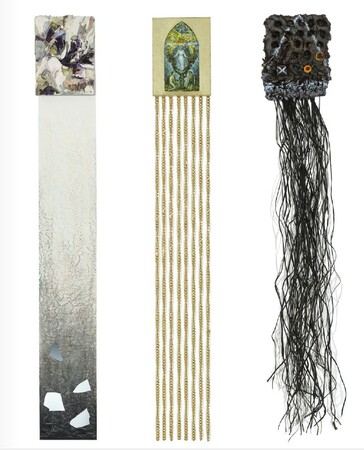
‘Through these three central themes, Mathieu Laca directs his work toward new interpretations and techniques while delving into art history to nourish his research, demonstrating the rich potential of a heritage that remains as significant as ever,’ says Etienne Ardaens, assistant curator at the Musée des beaux-arts de Mont-Saint-Hilaire.
An Unexpected Discovery
While conducting extensive research on Leduc, particularly in his archival fonds, Laca made a discovery that transformed his perception of the artist. Numerous clues tend to point to a forbidden love between Leduc and a young Saint-Hilaire poet named Guy Delahaye, a biographical possibility not previously addressed in books about the painter. Leduc’s marriage at age 43 to an older first cousin, abandoned by her husband and later widowed, had first raised his suspicions.
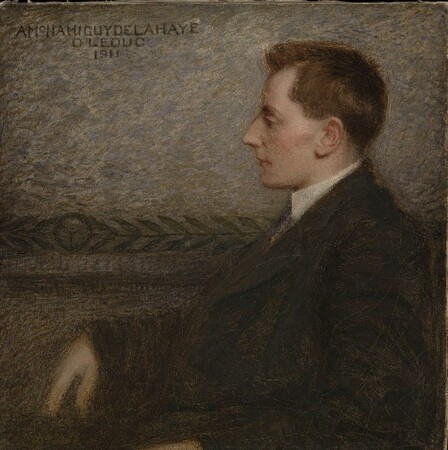 Guy Delahaye, Leduc’s alleged lover, painted by the artist. (MBAM)
The absence of any portrait of Leduc’s wife from his work also led Laca to consider the marriage one of convenience. Alongside the exhibition, he began writing a book on the subject, knowing the information opens an entirely new interpretation of an oeuvre whose symbolism may be less mysterious than it appears.
The prohibitions of the period prevented any love between Leduc and Delahaye from being fully realized. In 1910, homosexuality was condemned by the Church, criminalized by law and characterized by psychiatry as a form of ‘mental illness.’ Despite that climate, Leduc painted superb portraits of Delahaye, with dedications inscribed directly on the canvases. Laca was overwhelmed on discovering the portrait held by the Musée des beaux-arts de Montréal, in which the young poet appears in profile like a medallion of Ovid, accompanied by Erato, muse of lyric and erotic poetry. To him, it resembles a barely concealed declaration of love.
Although the relationship developed into friendship, the two continued corresponding and meeting regularly throughout their lives to discuss art, philosophy and science. Leduc later produced imaginary landscapes expressing his inner states.
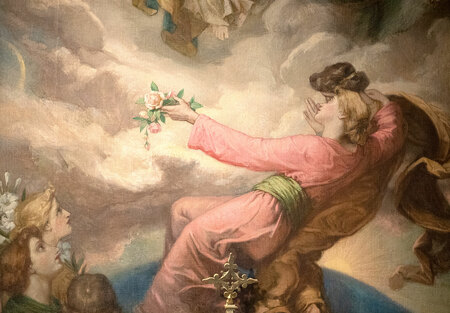 One of the religious frescoes painted in churches by Leduc
A Journey Toward the ‘Genius of the Mountain’
Having explored Québec art history in this way and translated it through the works shown at the museum, Mathieu Laca feels he has experienced it from within, through action rather than contemplation. He has absorbed its psychological forces and the inflections of its language. ‘My body retains the memory. The misunderstood symbolism of Ozias Leduc’s paintings now comes into new focus in light of the feelings he experienced for the poet Guy Delahaye. His painting appears as the sublimated expression of a forbidden love, something that resonates powerfully within me,’ he says. Paul-Émile Borduas, for his part, taught Laca the fierce desire to free oneself from everything that constrains creation. The underground stream whose gates he opened will not soon run dry. Jordi Bonet, that dazzling human poem, brought him into contact with the sacred. ‘Death has seemed less frightening to me since he tamed it,’ Laca concludes.
-------------
With this exhibition, Laca, a Laval native who still lives there, reaches another stage in his artistic vision. ‘I summarize my approach this way: portray people differently; write and paint simultaneously; paint portraits of writers and write about visual artists. This creative interweaving interests me profoundly because it carries new resonances. For me, the two arts operate as communicating vessels, allowing me to cross their respective boundaries freely by moving endlessly from one to the other.’
Curiously, the house Laca shares with his husband, Jean Comeau, faces a cemetery where a stone angel watches over the grave of Marc-Aurèle Fortin, another major Québec painter. ‘On misty days, I like to imagine the landscape artist on his bicycle, a canvas under his arm, searching for the ideal view of the great elms that have since disappeared.’
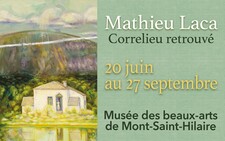
Correlieu retrouvé
Musée des beaux-arts de Mont-Saint-Hilaire
150, rue du Centre-Civique
Mont-Saint-Hilaire (Québec)
from June 20 to September 27, 2026
Artist-guided tours available:
Sunday, July 19, 2 p.m.;
Saturday, August 1, 1 p.m.;
Sunday, August 16, 2 p.m.;
Saturday, August 29, 1 p.m.;
Sunday, September 13, 2 p.m.; and
Sunday, September 27, 2 p.m.
Information: https://mbamsh.com/exposition/correlieu-retrouve/












 Sébastien, Heather, and their children.