Gérard Pourcel
The beach is reached from a turnoff on Route 362 between Saint-Irénée and Les Éboulements. The descent along a narrow, winding road is quite steep. At the foot of the slope, a second, very narrow road on the left is marked “Plage.” Continue for a few hundred metres to a parking area facing the shore, bounded by the tracks of the Charlevoix tourist train. The municipality has installed a dry toilet, a welcome amenity. Especially on fine summer days, the parking area may be full, and drivers will need some ingenuity to find a small space along the edge of the narrow road. Even though getting around is a little complicated, I have never seen an inconsiderate motorist block a private entrance or the road itself.
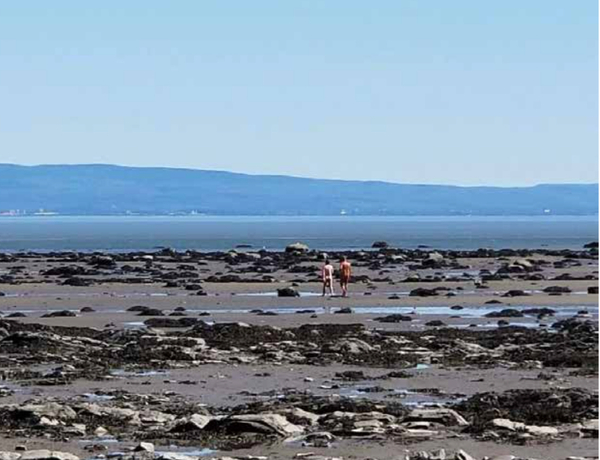
This is paradise before Adam and Eve, although their story predates Catholic iconography by a considerable margin. According to Michel Onfray, the three monotheistic religions share the story of Adam and Eve’s lost paradise, itself derived from the Greek myth of Pandora. At the northeast end of plage de Cap-aux-Oies, Eden is restored, without a vine leaf in sight. Onfray also notes that a vine leaf would be climatically implausible and that a fig leaf makes more sense. Either way, at plage de Cap-aux-Oies, no one cares whether the leaf is vine or fig.
In practice, the beach is loosely divided into three sections, without this causing any difficulty. The first, near the stairs, is heterosexual and clothed. Farther to the left is a heterosexual section where clothed and nude mix, followed by a naturist area populated chiefly by “Adams.” And should anyone partake of the forbidden fruit, which is by no means required, it will not fulfil the biblical injunction: “Be fruitful and multiply; fill the earth…”
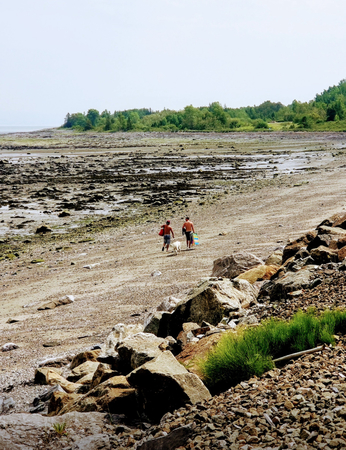
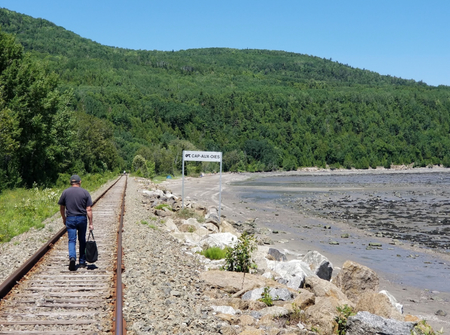
The beach itself is a very beautiful broad cove backed by the mountain, with many secluded and shady spots, but it is the sense of freedom that takes hold fairly quickly. Having visited several times, I have never felt uncomfortable there. There is no harassment. Sunbathers range from young people with sculpted bodies to much older people marked by the years: tall and short, heavy and thin. In late August 2024, I even saw a naturist walking with a cane. My impression is that everyone feels comfortable and free of self-consciousness. The beach is very clean; I have never seen greasy wrappers, old soft-drink cans or other litter. Farther northeast is another small, more secluded cove of fine sand, accessible only by walking a few hundred metres alongside the railway track.
I wish you paradise not at the end of your days, but the next time you pass through Charlevoix in summer.
Reference: Michel Onfray, Traité d’athéologie, Livre de poche/Éditions Grasset, 2005.
Acadie has several charming destinations in Nouveau-Brunswick, and the Lobster Capital of the World is a particular favourite with tourists and locals alike.
Located 25 kilometres from Moncton,
Shédiac
is the most popular seaside destination on the Côte acadienne. The provincial park at plage Parlee is very popular in summer. It was here, in this corner of Acadie on the edge of Moncton and the Nouvelle-Écosse border (where French faces strong competition from English), that shiac was born. This Acadian dialect, which blends Acadian French and English, takes its name from a contraction of Shédiac and is heard far less often in the north of the province.
About twenty kilometres farther south, the Plage de l’Aboiteau in Cap-Pelé, vast, deep and still largely in its natural state, is one of the finest warm-water ocean beaches in Nouveau-Brunswick.
Shédiac has declared itself the Lobster Capital of the World. The town is internationally known for lobster fishing and, in early July at the end of the fishing season, holds the Festival du homard, which marked its 75th anniversary in 2024. For lobster lovers, then, it's a must-visit destination. Since 1989, to underline its title, the town has boasted a monument that delights the thousands of visitors passing through the region: a giant lobster that presides over the middle of town, where people love to have their picture taken.
The town has several charming inns and good restaurants. For a gay-friendly stay, the Gite Le Griffon on the main street welcomes you into a grand heritage home. The plunge into the Alice in Wonderland universe that inspired the hosts continues at Moque-Tortue, a playful bistro just a few steps away, where lively evenings spill onto the terrace in summer. This wonderland now also includes the chocolaterie and bistro Adorable Chocolat across the street, and the Morse & Marteaux food counters at Plage Parlee and the ciné-parc Neptune, run by the same entrepreneurs with the same magic.
When exploring Lac Saint-Jean, certain places are not to be missed because of their relevance and their cultural and human interest. Between Alma, the gateway to the journey, and Péribonka, some of them deserve a longer stop.
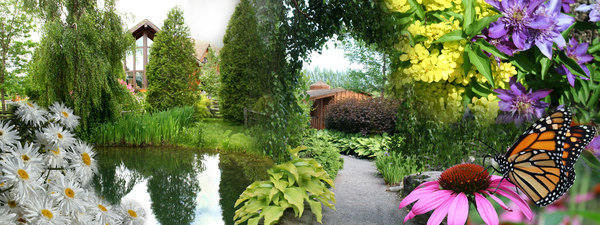
In L’Ascension, Jardin Scullion, one of Québec’s most beautiful gardens, contains more than 2,000 plant species from around the world, all well adapted to the distinctive climate of Lac-Saint-Jean. It also has a small farm, children’s play areas and three kilometres of walking trails with interpretive panels in three languages.
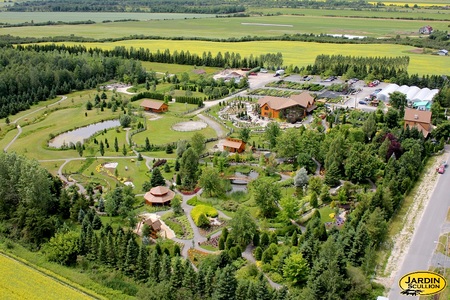
Jardins Scullion
1975, Rang 7 Ouest
L'Ascension-de-Notre-Seigneur, QC G0W 1Y0
jardinscullion.com
(418) 347-3377
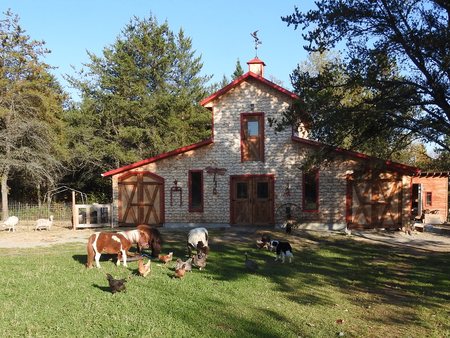
In Péribonka, Dany welcomes visitors to Ferme Dan Nature to meet
more than 30 species of farm animals and exotic birds, from
alpacas to peacocks and pheasants.
A beautiful water garden filled with lotus flowers invites visitors to explore the two-kilometre interpretive trail.
At this gay-friendly venue, tours are led by the host and visitors can pick their own blueberries and raspberries. Guests can also stay in a beautiful log cabin.
Ferme Dan Nature
650 Rang St Michel,
Péribonka, QC G0W 2G0
Facebook page
(418) 719-1343
A visit to the Shippagan region would not be complete without trying its restaurants. Some celebrate local traditions and regional culture, while others offer different and exciting culinary adventures.
In Shippagan, near the bridge to the islands of Lamèque and Miscou,
Pinokkio – Pizzeria Resto-Bar
offers panoramic views of the surrounding area. Its wood-fired white- and rosé-sauce pizzas, starters, salads, pasta, seafood and steaks delight diners. The menu combines international and regional cuisine. The moules marinières in a creamy white-wine sauce are particularly delicious, and the seasonal outdoor terrace is popular.
On the Haut-Shippagan side, on the Cielo Glamping site, the Hub chez Cielo has developed a different dining concept that offers a unique culinary and creative experience. The chef has made it his mission to introduce you to the region’s products through the Planches Cielo concept: you build your own meal from the shop’s offerings. The Perles et huîtres package is also popular. You can also enjoy coffee from the roastery or savour one of the famous cocktails, their famous wines and local beers.
On the island of Lamèque, there is no shortage of interesting places. Café boutique Aloha on rue Principale, for example, has Hawaiian-inspired décor and an exotic menu featuring homemade carrot-and-turnip soup, corn chowder, poke bowls, filled paninis, bagels and baguettes, a tempting Aloha salad and its famous Crookies, baked fresh daily. It also serves smoothies. A pretty terrace at the rear welcomes guests in season, and the gift shop is filled with all sorts of practical and playful things.
Nearby, Restaurant du Malia Spa et Villégiature offers a varied menu centred on seafood, along with tempting breakfasts. Its Taco Wednesdays are especially popular.
When a restaurant takes its name from a great wine, diners can expect superior-quality food made with fresh ingredients. A quintessential family restaurant, Kabernet Gourmet-pub serves a wide range of starters, chef’s selections, burgers, meats and fish, as well as an extensive dessert menu. Its wine and spirits list offers remarkable variety and choice. Tables can be reserved from Thursday to Sunday.
On the island of Miscou, Vieille école de Miscou serves breakfast to overnight guests and welcomes passers-by for
coffee or a light meal from a menu that changes through the season. Do not miss the Festival du thon in August and its festive menu for
the occasion.
In December 2010 in Natashquan, Minganie, representatives of socioeconomic, tourism, municipal, government and business organizations gathered for a forum. They concluded that a cooperative approach would allow the community to coordinate more effectively and develop a tourism offering beneficial to visitors and the region itself.
Jacques Lachance, one of the people who initiated this process of reflection and coordination among local and regional forces, arrived in Natashquan in the early 1970s with his sheep, after spending time as an antiques dealer and horse-drawn-carriage driver in Vieux-Québec. A lover of heritage, the Saint-Laurent and nature, he had travelled widely and worked in many fields before settling where his heart drew him.


Now a consultant, producer and project lead in tourism development and promotion, he says the Coopérative de solidarité en tourisme équitable (CoSte) serves as a catalyst for political and socioeconomic stakeholders throughout Minganie and even across Côte-Nord, thanks to its original, energetic approach to showcasing the region and its attractions.
During our meeting on the terrace behind CoSte’s head office, he described with energy and conviction what led him to join an undertaking of which he is now very proud. He lives in Rivière-au-Tonnerre and remains regularly involved in the agency’s tourism activities, notably as a guide accompanying groups to destinations across Minganie.
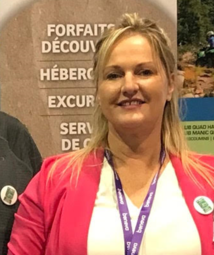

Since 2006, the Agence coopérative de solidarité en tourisme équitable, or CoSte, has organized and marketed tourism experiences in Minganie and Basse-Côte-Nord. It showcases the natural environment and local people, gives travellers lively, dynamic, authentic and memorable experiences, and maximizes positive benefits for communities.
The travel agency has a visitor reception office and offers accommodation at L’Escale Lam-Air in Rivière-au-Tonnerre. Its packages and tourism services cover Côte-Nord, particularly Minganie, Anticosti Island and Basse-Côte-Nord. ‘CoSte contributes to the growth of local communities by encouraging sustainable, responsible and equitable tourism,’ Lachance says. It offers a wide range of services: flight reservations, cruises in the golfe du Saint-Laurent, tailor-made packages and à-la-carte products.

Initially housed in a small building near the church, the cooperative received an unexpected ‘gift’ in 2013. The owners of the motel in the centre of the village were retiring and, recognizing the importance of CoSte’s work and achievements, donated the property to the cooperative. The waterfront complex offered an ideal opportunity to expand its services and packages.
With Alberte Marcoux arriving as the new executive director that same year, CoSte established its head office in the front section of the building and also took over management of L’Escale Lam-Air’s dining room and 13 guest rooms. The gift certainly acted as a wonderful boost for the organization and its members.
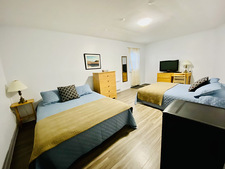
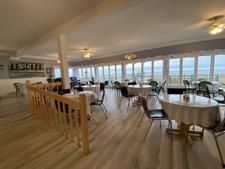
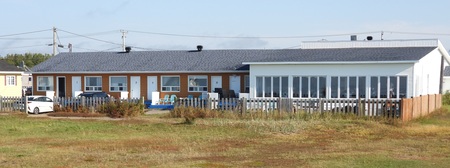
‘Voyages CoSte received start-up funding, but the cooperative has been completely self-supporting since 2016,’ Jacques Lachance explains. ‘We have received no public operating funding for nearly 10 years. The assistance we do receive is essentially tied to specific development projects, such as purchasing a minibus or carrying out a collaborative digital transition with 40 member businesses.’ The collectively owned enterprise supports itself through sales and belongs to members based mainly in the MRC du Golfe du St-Laurent and MRC de la Minganie, including Anticosti Island.
CoSte has received support and encouragement from Tourisme Québec, the ministère du Développement économique, de l’Innovation et de l’Exportation, the Centres locaux de développement (CLD) in Minganie and Basse-Côte-Nord, the Conférence régionale des élus de la Côte-Nord and Emploi-Québec. These partners contributed in various ways to the start-up phase. The cooperative also works with other local and regional partners to deliver projects and its diverse range of tourism services.
They see this community-born initiative as an enterprise that could, over time, become a model of collective development and local empowerment for northern Québec communities.
Many Canadian agencies, meanwhile, believe CoSte opens a vast and little-known territory to travellers in an original and respectful way. Without it, the region would remain difficult to reach and offer relatively few options for trouble-free travel. CoSte places the experiential character of its packages at the forefront, matching the expectations of a new generation of travellers seeking experiences.
One thing is certain: CoSte occupies an increasingly important place in Minganie tourism. Guides GQ representatives saw this directly and used a few of its services and packages last August and September. (See ‘Eight Days Exploring Minganie.’)

Voyages CoSte
voyagescoste.ca
454, Jacques-Cartier
Rivière-au-Tonnerre, QC G0G 2L0
1.877.573.2678 or 418 465-2002
Republished on March 20, 2026
By Gaëtan Vaudry
Upon the announcement of my visit to Saguenay-Lac-Saint-Jean, the well-informed promptly provided me with a list of the finest dining spots not to be missed in the region. Among them was the table at the O'Batillage restaurant, offering exquisite local cuisine within the Auberge des Battures in the town of La Baie. Chef Étienne Trottier ensures a local supply that introduces us to the best of the boreal forest and regional producers. Even though we were in the low season of November, the team at O'Batillage welcomed us wonderfully. For my part, I was treated to a three-course meal, starting with smoked salmon from La Boucanerie d’Henri. Beyond this salmon, which I believe is the best in Quebec, the dish included a Frambleu coulis (from Domaine Le Cageot), cucumbers, flaxseed oil (from Ferme Tournevent), capers, raspberries, and puffed wild rice. An unmissable starter!
For the main course, I chose the seafood pasta featuring fresh tagliolini (La Prod LP) in Mornay sauce, Matane shrimp, Prince Edward Island mussels, Iles-de-la-Madeleine scallops, white fish, and sea lettuce. A generous portion that satisfies hearty appetites. Of course, we always save room for dessert, and I was tempted by an excellent crème brûlée. I could not have made a better choice!
Experiencing the restaurant at Auberge des Battures is certainly a delight for the taste buds, but it is equally pleasing for the eyes. Throughout my substantial meal, the establishment, managed by Mr. Éric Civel, offered me an unparalleled view of the Saguenay Fjord. A feast for all your senses.
Restaurant O'Batillage / Auberge des Battures
6295, boulevard de la grande Baie Sud Saguenay, La Baie district
418 544-8234
https://obatillage.com
Long renowned throughout the 20th century for shipbuilding, when large vessels would depart to transport timber overseas, Shippagan also saw significant growth in its fishing industry, ultimately becoming New Brunswick's most important fishing center.
It's no surprise that each year, Shippagan invites friends to celebrate at the New Brunswick Fisheries and Aquaculture Festival, which draws thousands of visitors. Today, it's the peat bog exploitation industry that is experiencing significant growth in the town and regional economy, creating hundreds of jobs.
The University of Moncton operates and manages a campus here, where hundreds of students from various regions and abroad complete programs such as a Bachelor's in Sustainable Development and Coastal Zones, Information Management, Nursing, Technology, Information and Leadership, as well as Diplomas in Business Administration and Health Sciences, among others.

Located slightly off the beaten path, about 15 km from Highway 11 which connects Caraquet, the regional capital, to Tracadie-Sheila, the town of Shippagan offers an abundance of outdoor activities, whether it's camping, kitesurfing, sailing, cycling, sea swimming, or simply relaxing on sandy beaches.
Situated between Saint-Simon Bay and the channel of Chaleur Bay leading to the Gulf of St. Lawrence, Shippagan presents magnificent landscapes that can be discovered through its numerous cycling circuits and the shoreline trail that runs behind downtown. Additionally, the Acadian Peninsula Véloroute provides access to the entire Peninsula and features rest areas along its route.

Shippagan houses the New Brunswick Aquarium and Marine Centre. Beautiful aquariums showcase the rich collection of fish and invertebrates from the Gulf of St. Lawrence. Several grey seals are also on display, and visitors can touch seafood and other marine creatures.
The Haut-Shippagan area features a truly unique resort destination: Cielo Glamping. Guests can sleep in fully equipped domes, complete with a terrace and spa, offering direct access to the bay. It's one of the premier spots to disconnect while fully embracing everything nature has to offer. Come share a meal at its Hub where the chef prepares dishes using local ingredients, enjoy coffee from the roastery, or savor a local beer.
Vieux-Québec and Vieux-Port
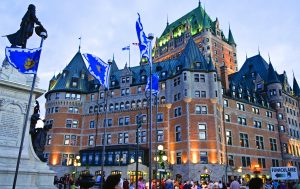
Walking in the streets of Vieux-Québec is like following in the steps of the pioneers who gave birth to this nation. Founded by Samuel de Champlain as a trading post in 1608, the colony first developed around l’Habitation de Québec before expanding into the first streets traced around the Place Royale in the heart of the Vieux-Port. Restored in the early 1970s, this historical district brings us back in time to the capital of Nouvelle-France (New France) at the end of the 17th century. This was the era of Louis XIV, a bust of whom adorns the area. As I myself am a descendant of Mathurin Gagnon, who was one of the first merchants of Québec and whose home and retail store were located at the current site of the Sault-au-Matelot park (or Parc de l’Unesco), walking on the cobblestones of these historic sites is like reconnecting with the history of our roots in this country. A few steps away, Place Royale is the main site of the annual Fêtes de la Nouvelle-France, recreating the French colonial era of its original inhabitants.
In the Vieux-Port, one must absolutely visit the Musée de la Civilisation. The neighborhood is home to many gay-friendly establishments, among them the restaurant Marie-Clarisse, which was opened at the foot of the Casse-Cou staircase by nenowned chef Serge Bruyère.
Heading up to Haute-ville, one can admire the elements of fortification which have made Québec unique, for it is the only still-fortified city in North America. It is the neighborhood commonly reffered to as Vieux-Québec. Built at the end of the 19th century near the Citadelle fort, the hotel Château Frontenac rises above Place Royal on one side of the Terrasse Dufferin. The latter is a splendid walkway offering a spectacular view of the area and is perfect for romantic strolls. One can easily understand why the founders of Québec chose this strategic spot to establish the colony, which would become the capital of New France, then Lower Canada and finally, Québec.
The gay lifestyle took root fairly early in Vieux-Québec. The Sauna-hôtel Hippocampe on Mac Mahon Street, the oldest gay establishment still operating in the province (where some might recognize the interiors used for Robert Lepage’s film Le Confessionnal), has been open for over four decades. The owner, Yvon Pépin, had previously tended bar in many Vieux-Québec clubs, in a time when homosexual life was still mostly underground.
André Gagnon
Sillery, Sainte-Foy and Cap-Rouge
Sillery, Sainte-Foy and Cap-Rouge have the reputation of being the more affluent neighborhoods of the capital. This area is home of the main campus of Université Laval, the oldest francophone higher education establishment in America, where the first LGTBQ organization in the capital, the Groupe gai de l’Université Laval, first appeared.
Whether arriving in Québec from the south shore using the highway or the Chemin du Roy, or coming in from the international airport, one inevitably crosses this district before accessing downtown Québec. There are also many hotels in the vicinity of the bridges, especially along Laurier Boulevard. This might be the more practical choices for those coming into the city by car, as the old narrow streets of Old Québec where obviously conceived for horse-drawn carriages and pedestrians, not cars. Shoppers will appreciate the proximity of the shopping malls also found on Laurier Boulevard.
Coming over the bridges from this district, you should visit the Promenade Samuel –De-Champlain park along the river, which was inaugurated in 2008 for the 400th anniversary of the city. Whether arriving by foot, bike or car, the promenade offers a spectacular view of the city and leads right into historic Old Québec. This is a great way to connect with a natural environment in the heart of the city.
Sillery is certainly the most affluent neighborhood of the capital. Its trendiest street, Maguire Avenue, is an area especially appreciated by our community, offering quaint boutiques, with good restaurants and nice terraces. It also features one of the most remarkable parks in the city, Spencer Wood, which became a showcase for horticulture in North America through the efforts of its owner, Henry Atkinson. For nearly 20 years, the governor-generals of United Canada lived on the property, which was purchased by the Québec government in 1870 and served as the residence of Québec lieutenant-governors until 1966. A major fire eventually destroyed the main residence. Visit the gorgeous park by the Saint Lawrence River, the beautiful gardens and relics of the site's long history.
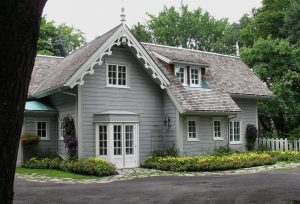
Villa Bagatelle, with its distinctive irregular forms and ornamentations, was built in the picturesque English architectural style of the 19th century. The cultural centre hosts temporary art and history exhibitions. The Villa is also renowned for its garden where you can admire many native plants and a range of underbrush species.
Also noteworthy is the Aquarium du Québec, with its gardens and outdoor tanks, and a main building featuring many exhibition spaces. The venue includes nearly 10 000 specimens representing 300 species of mammals, indigenous and exotic fish, invertebrates, amphibians and reptiles. Watch marine mammals, such as polar bears, walruses and several seal species, frolic in the outdoor park. Many animals from the Pacific Ocean swim in our huge 350 000-litre tank. The area overlooks the Saint Lawrence River from atop a cliff, an excellent way of discovering these faraway regions.
Crossing the Matapedia Valley, one reaches the Restigouche River, into which the Matapedia flows. The Restigouche empties into the Chaleur Bay in the heart of the Appalachians. It is a river globally renowned as a salmon river and part of Canadian heritage. The name Restigouche comes from the Anglicization of Listuguj, the name of the Mi'gmaq community that camped along its banks hundreds of years before the arrival of the first French colonizers. Even today, the community of Listuguj, one of the most significant Mi'gmaq communities in the Maritimes, stands on the Quebec side opposite the town of Campbellton in New Brunswick.

On the right bank of the Restigouche, the newly merged town of Campbellton forms, along with the communities of Listuguj and Pointe-à-la-Croix connected by the interprovincial bridge, the most significant conurbation in the Chaleur Bay with its some 15,000 inhabitants.
The Mi'kmaq called the site Wisiamkik, meaning muddy place, referring to the sediments in the narrows of the Restigouche. The site was named Pointe-des-Sauvages around 1700 during the French colonial era, and a small village was founded there by deported Acadians in 1755, while more than 1,000 deportees settled across in Petite-Rochelle. This significant village only had a brief existence as it was razed under the orders of James Wolfe after the fall of New France in 1760. The site became a mere trading post for decades as the Acadians dispersed and founded various villages around Chaleur Bay. The town truly emerged with Scottish immigration to the region in the early 19th century. The town originally bore various names. The current name was given in 1833 in honor of Sir Archibald Campbell, Lieutenant-Governor of New Brunswick from 1831 to 1837.